Everything You Need to Know About Industrial Control Panel Identification
- Jul 6
- 12 min read
Updated: Jul 13
When designing an industrial control panel, most of the attention goes into the electronics, PLC, wiring and software. Yet one of the most overlooked aspects of any control system is the way the operator interacts with it.
From push button legends and selector switches to stainless steel enclosure doors and safety information, control panel identification plays a critical role in safety, usability and long-term reliability.
The good news is that today's panel builders have more choice than ever before.
When you think of industrial labels, how many of you think "Traffolyte"? It's a word that still floats about as the industry standard material, but in reality it hasn't been an industry standard material for quite some time! if fact, it's considered quite "old hat" and not used anywhere as much as you may think.
Traffolyte is actually a brand name, not a material. Over the years it's become a generic term (like Hoover or Velcro) for phenolic engraved laminate. Today, most front engraving is done on modern acrylic-based laser laminates, rather than true phenolic Traffolyte.
The important thing to understand is that modern engraving laminates haven't replaced Traffolyte because Traffolyte was poor—they've become the preferred choice because they offer greater flexibility for today's manufacturing methods.
The table below provides a technical overview of the differences between modern laser engravable laminate and traditional phenolic Traffolyte, including material properties, manufacturing methods and typical applications.
Feature | Modern Front Engraved Laminate | Traditional Traffolyte (Phenolic Laminate) |
Material | Acrylic-based laser engravable laminate | Phenolic resin laminate (original Traffolyte) |
Common Thicknesses | 0.8 mm, 1.5 mm, 1.6 mm, 3.2 mm | Typically 1.5 mm or 3.2 mm |
Manufacturing Method | Precision laser engraving and laser cutting | Rotary engraving and mechanical routing |
Edge Finish | Clean laser-cut edges with intricate detail | Mechanically routed edges, less detailed engraving |
Detail Resolution | Excellent for fine text, logos and graphics | Good, but limited by cutter diameter |
Minimum Text Size | Very small, crisp lettering possible | Larger text generally recommended |
Available Colours | Hundreds of colour combinations | Limited colour range |
Graphic Capability | Excellent for logos, symbols and complex layouts | Primarily text and simple graphics |
Internal Cut-outs | Extremely accurate laser-cut apertures | Machined using rotary cutters |
Tool Wear | None | Engraving cutters require replacement |
Production Speed | Very fast once programmed | Slower due to mechanical machining |
Repeatability | Extremely high | High, but dependent on tooling condition |
Material Waste | Low | Slightly higher due to machining |
UV Resistance | Excellent | Excellent |
Chemical Resistance | Very good | Excellent |
Electrical Insulation | Good | Excellent (one reason it became popular) |
Typical Applications | Modern control panels, machine builders, OEM equipment, electrical enclosures | Legacy industrial panels, switchgear, substations, railway and heavy industry |
Typical Appearance | Clean, modern and precise | Traditional industrial appearance |
Still Widely Used? | Yes – the industry standard for new work | Increasingly replaced by modern laser laminates, but still specified in some sectors |
So, Is One Better Than the Other?
In a word... no.
Like most engineering decisions, the right material depends entirely on the application.
For the vast majority of modern control panels, machine builders and OEM equipment, modern laser engravable laminates are our first choice. They offer exceptional engraving quality, a huge range of colour combinations, intricate laser-cut detail and a clean, contemporary appearance. They're also ideal for complex layouts with logos, symbols and precisely machined cut-outs.
That said, Traffolyte certainly isn't obsolete.
In fact, we still manufacture Traffolyte panels and labels for a small number of customers, and in those applications, we'd recommend it ourselves.
Why?
Because some industries value continuity just as much as innovation. If a customer has been using Traffolyte for decades, replacing a single panel or adding an extension in a different material can leave the finished installation looking inconsistent. Matching the existing specification is often the right engineering decision, even if newer materials are available.
There are also applications where the traditional phenolic construction of Traffolyte is preferred due to long-established company specifications, industry standards or customer requirements. In these cases, changing material simply because something newer exists doesn't necessarily improve the finished product.
Javo Insight
Years ago we had a customer who insisted on genuine Traffolyte rather than modern laminate. His reason? He was wiring panels with a cigarette permanently hanging out of his mouth and regularly dropped ash—or occasionally the cigarette itself—onto the panel. Phenolic Traffolyte coped far better with this abuse than the modern alternative.
We don't believe in forcing every job into the same solution. We choose the material that best suits the application, whether that's a modern laser engravable laminate, traditional Traffolyte, stainless steel, anodised aluminium or direct laser marking onto the enclosure itself.
Ultimately, the best specification isn't the newest material—it's the one that delivers the right balance of durability, appearance, manufacturability and long-term performance for the environment in which it will be used.
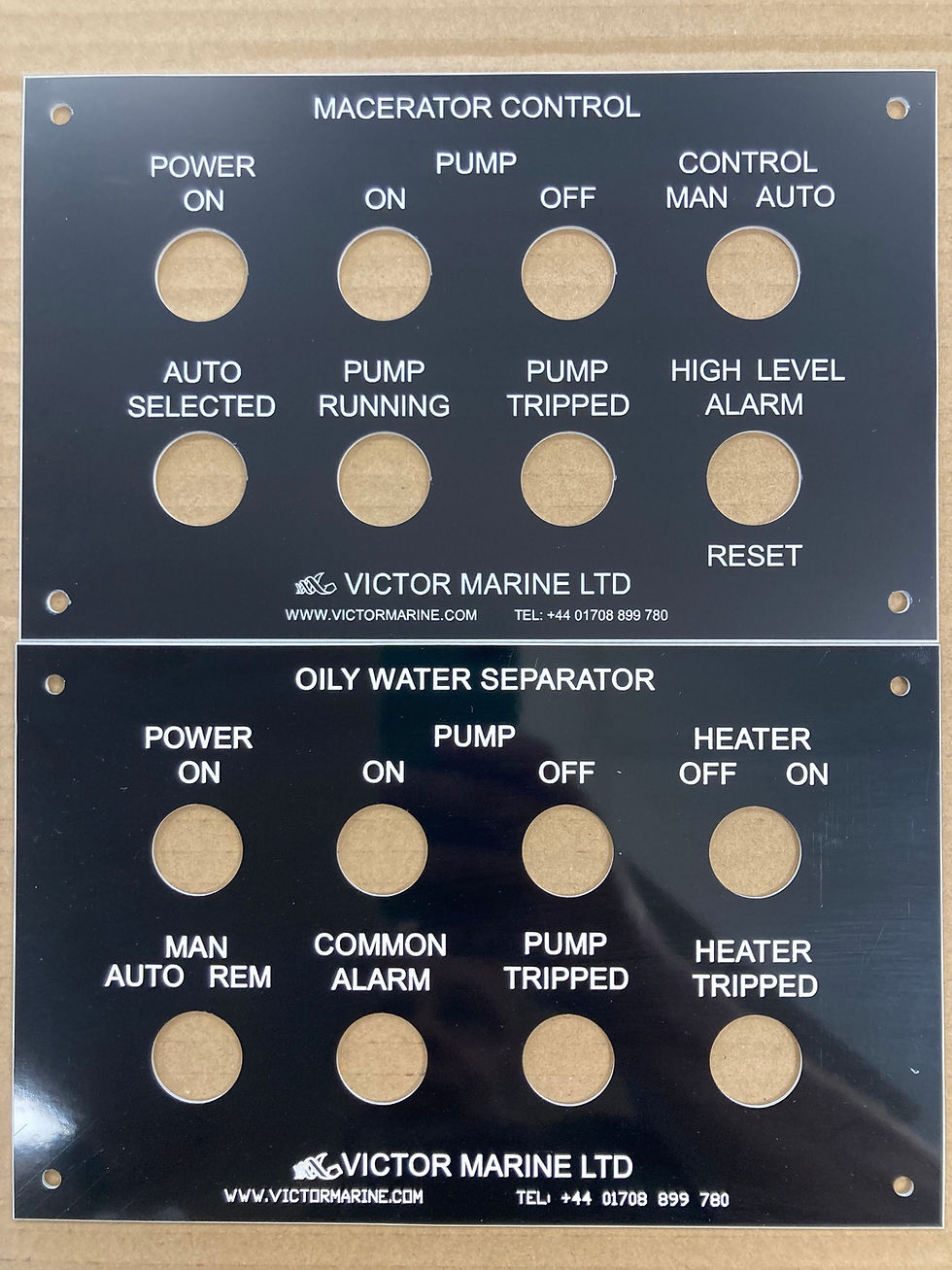
The photograph below illustrates the difference particularly well. The upper panel has been manufactured from a modern laser engravable laminate, while the lower panel is traditional Traffolyte. Both panels perform the same function and both are perfectly suitable for industrial use, but the manufacturing processes produce noticeably different results. The laser engraved laminate delivers exceptionally crisp text, sharp edges and faithfully reproduces fine details such as company logos and small lettering. By comparison, the mechanically engraved Traffolyte panel produces a more traditional appearance, although some of the finer detail is inevitably lost due to the diameter of the engraving cutter. Neither is inherently 'better' than the other—the choice simply depends on the application, the customer's specification and the desired finished appearance.
Javo Insight
Most engineers still ask for "Traffolyte".
Around half the time, what they actually want is a modern laser laminate.
Reverse Engraved and Paint Filled Control Panels
While front engraved laminates are the most common choice for industrial control panels, there are several applications where a more premium finish or additional durability is required. This is where reverse engraved and paint-filled laminates come into their own.
Unlike traditional front engraving, the artwork is engraved into the rear surface of a clear acrylic laminate. The engraved areas are then carefully paint filled before the rear of the panel is colour coated. When viewed from the front, the text and graphics appear beneath a perfectly smooth surface, completely protected from the outside environment. This is especially useful in high wash down and high Hygiene areas.
The result is a control panel that combines excellent aesthetics with exceptional durability.
Why Choose Reverse Engraving?
Reverse engraving offers several advantages over conventional front engraved laminates.
Completely smooth front surface with no engraved recesses.
Text and graphics are protected beneath the acrylic face.
Excellent resistance to dirt, grease and repeated cleaning.
Premium appearance with a high-quality gloss finish.
Ideal for detailed logos, fine graphics and corporate branding.
Suitable for demanding industrial and commercial environments.
Perfect for hygiene and high washdown areas.
Because the engraved information is protected behind the face material, it cannot be worn away through normal use. Even aggressive cleaning won't affect the engraved legends, making this process particularly popular for operator interfaces that are handled frequently.
A More Modern Appearance
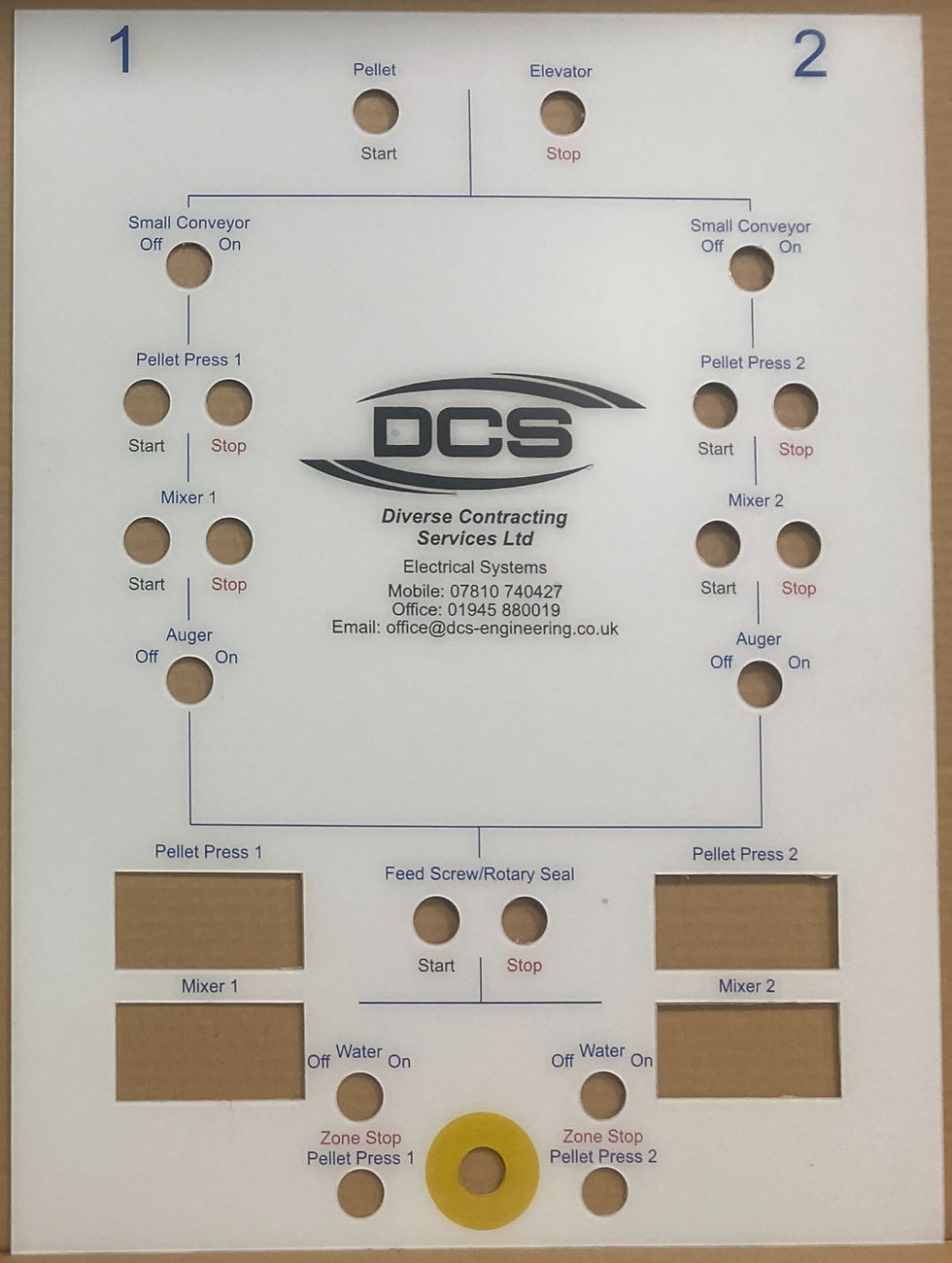
The control panel shown above is a good example of reverse engraving in practice.
Rather than exposing the engraved text on the surface, all graphics, switch legends and company branding are protected beneath the clear acrylic face. This creates a clean, modern appearance while providing excellent contrast and long-term durability.
Reverse engraving also allows complex company logos, coloured graphics and intricate layouts to be reproduced with exceptional clarity, making it particularly well suited to OEM machinery where appearance is just as important as functionality.

Javo Insight
One of the biggest advantages of reverse engraved control panels is that the operator never actually touches the engraved information.
Every button press, every wipe-down and every routine clean contacts only the smooth acrylic surface, while the text and graphics remain permanently protected underneath. For machines that are cleaned regularly or operated continuously throughout the day, this can significantly improve the long-term appearance of the control panel.
Before specifying reverse engraving...
✔ Will the panel be cleaned regularly?
✔ Is appearance important?
✔ Is the panel exposed to chemicals?
✔ Will operators touch it frequently?
If yes, then yes!
Emerging Materials
Multi-Colour Engraving Laminates
For many years, front engraved laminates were typically manufactured using two contrasting layers—for example, a black surface with a white core, or a white surface with a black core. While these materials remain the industry standard, newer engraving laminates are now available that offer three-colour construction, opening up new possibilities for industrial control panels and safety signage.
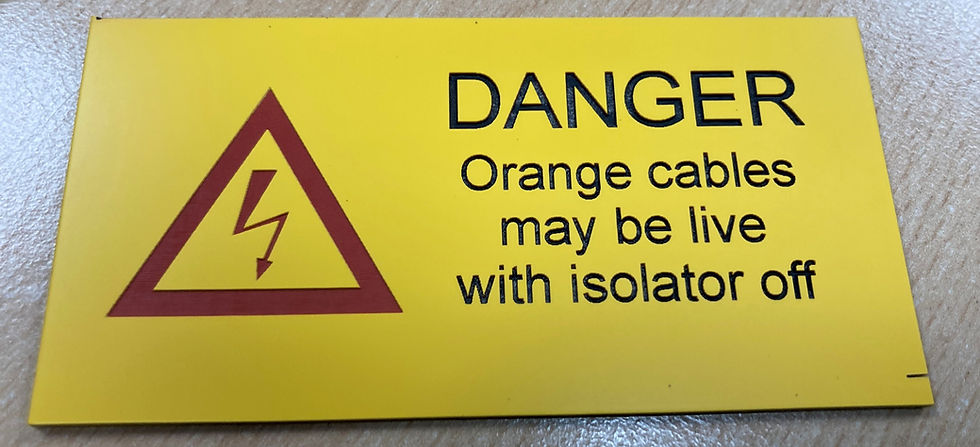
The warning label shown below is a good example.
The surface material is yellow, but beneath it are two separate coloured cores: one black and one red. By carefully controlling the engraving depth, different elements of the design can reveal different coloured layers within the same piece of material.
In this example, the warning text has been engraved to expose the black core, while the electrical hazard symbol has been engraved more deeply to reveal the red core, producing a professional multi-colour warning label without the need for printing or additional graphics.
How Does It Work?
Rather than engraving the entire design to a single depth, the laser engraves the artwork in multiple stages.
The first engraving pass removes only the yellow surface layer, exposing the black core.
Selected elements are then engraved a second time, removing the black layer to reveal the red core beneath.
The result is a permanent, high-contrast label with multiple engraved colours, all produced from a single sheet of material.
Where Is It Used?
Three-colour engraving laminates are particularly well suited to applications where important information needs additional emphasis without relying on printed graphics.
Typical applications include:
Electrical hazard labels
High-voltage warning signs
Machine safety notices
Fire alarm and emergency system labels
Control panel warning plates
Equipment identification requiring colour-coded information
Because the colours are integral to the material itself, they cannot peel, flake or wear away like printed labels. The finished product retains the durability expected from engraved laminates while providing much greater design flexibility.
More Than Just Better Looking
The ability to expose multiple colours from a single material isn't simply about aesthetics—it can improve communication.
By using colour selectively, designers can draw attention to critical information, distinguish warning symbols from supporting text or highlight specific operating instructions. This makes labels easier to interpret at a glance while maintaining the durability and permanence required in industrial environments.
Powder Coated Control Panels with Laser Etched and Paint-Filled Markings
Over the last few years, we've seen a noticeable increase in the number of customers specifying powder coated control panels with laser etched, paint-filled markings. In particular, this process has become increasingly popular with OEMs, control panel builders and industrial automation companies looking for a premium finish without compromising durability.
Unlike traditional engraved laminates or applied labels, the control panel itself becomes the finished product.
The panel is first manufactured from metal—typically aluminium or steel—and powder coated in the desired colour. Once coated, a fibre laser is used to selectively remove the powder coating, exposing the metal beneath while simultaneously creating a shallow engraved recess. The engraved areas are then carefully paint filled, producing crisp, high-contrast legends that become an integral part of the panel.
The result is a control panel that combines the durability of powder coating with the appearance of a professionally engraved front plate.
Why Is This Becoming More Popular?
For many machine builders, the appeal goes far beyond aesthetics.
Because the legends are created directly on the finished panel, there is no need to manufacture, stock or fit separate engraved labels. The finished control station has a clean, uncluttered appearance, with every legend perfectly aligned to the switches, indicators and HMI cut-outs.
This approach also gives designers much greater freedom when specifying colours. Rather than being limited to standard laminate combinations, the powder coat colour and paint fill can be selected to complement company branding, improve operator visibility or match the overall design of the machine.
We've seen customers choose everything from subtle monochrome finishes to high-contrast safety colours depending on the application.
Durable Enough for Industrial Environments
While the finished appearance is often what first attracts customers, durability is equally important.
The powder coated surface provides excellent resistance to corrosion and general industrial wear, while the laser etched and paint-filled legends remain permanently bonded to the panel. Unlike applied vinyl labels, there are no edges to lift, no adhesives to fail and no separate components to become detached over time.
This makes the process particularly well suited to:
Industrial automation equipment
Electrical control panels
Machine control stations
OEM machinery
Process control systems
Bespoke operator panels
Precision Without Compromise
One of the biggest advantages of laser etching is the level of detail that can be achieved.
Fine text, complex logos, multiple languages, electrical symbols and intricate panel layouts can all be reproduced with exceptional consistency. Because the laser is digitally controlled, every panel within a production run is engraved to exactly the same standard, making the process ideal for both one-off prototypes and volume manufacture.
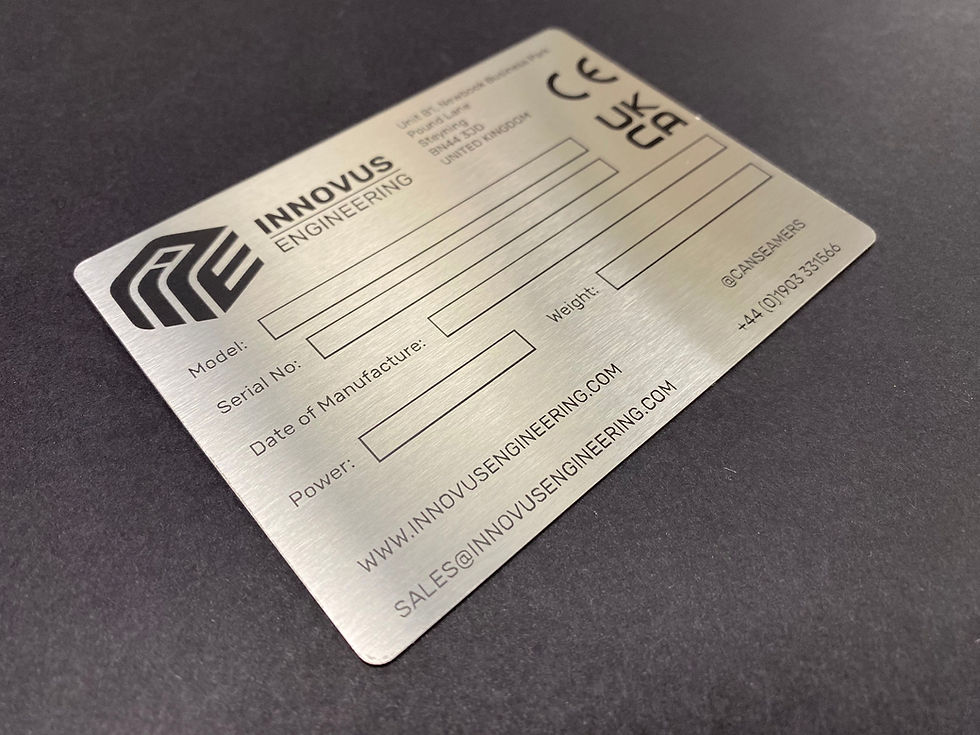
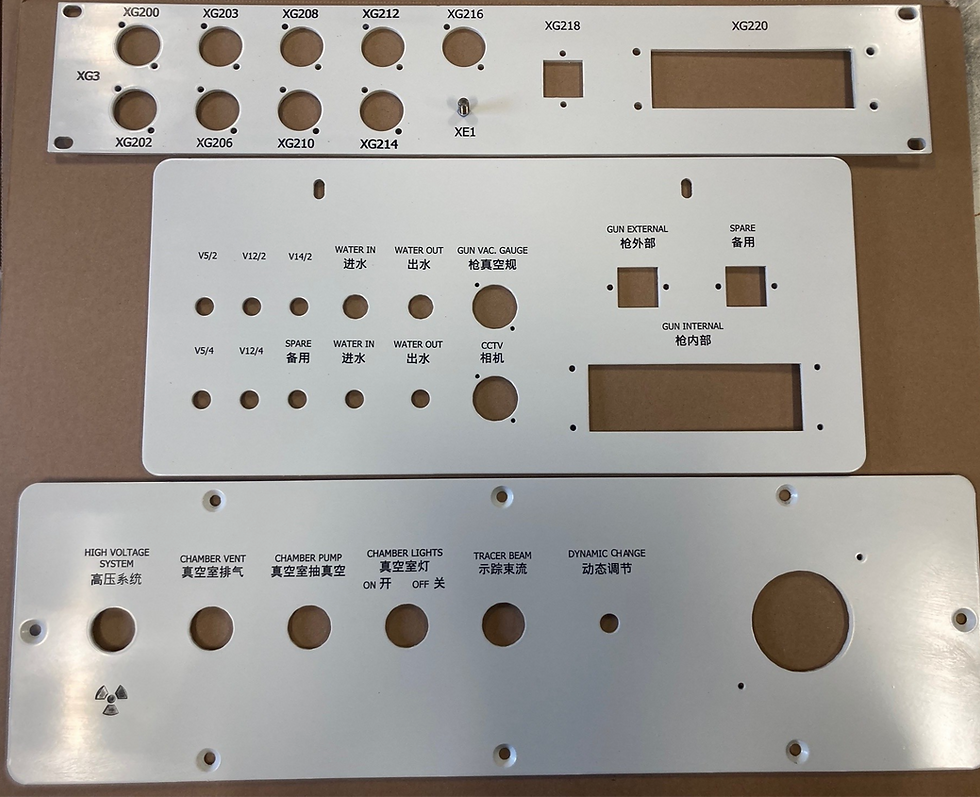
The examples shown below demonstrate how powder coated panels can accommodate everything from simple operator legends to complex layouts incorporating multiple push buttons, selector switches, indicator lights and HMI displays, while maintaining a clean, professional appearance.
Javo Insight
One of the reasons we believe this process has become so popular is that it combines the best aspects of several traditional methods. Customers retain the durability and premium feel of a powder coated metal panel, while benefiting from the precision of laser engraving and the clarity of paint-filled legends. The result is a control panel that not only looks professional when it leaves the factory, but continues to do so after years of industrial use.
Unlike screen printing, digitally printed graphics or applied labels, laser etched and paint-filled markings become a permanent part of the control panel, making them ideal for demanding industrial environments where durability and long-term readability are essential.
The Part becomes the panel - The Rise of Direct Component Marking.
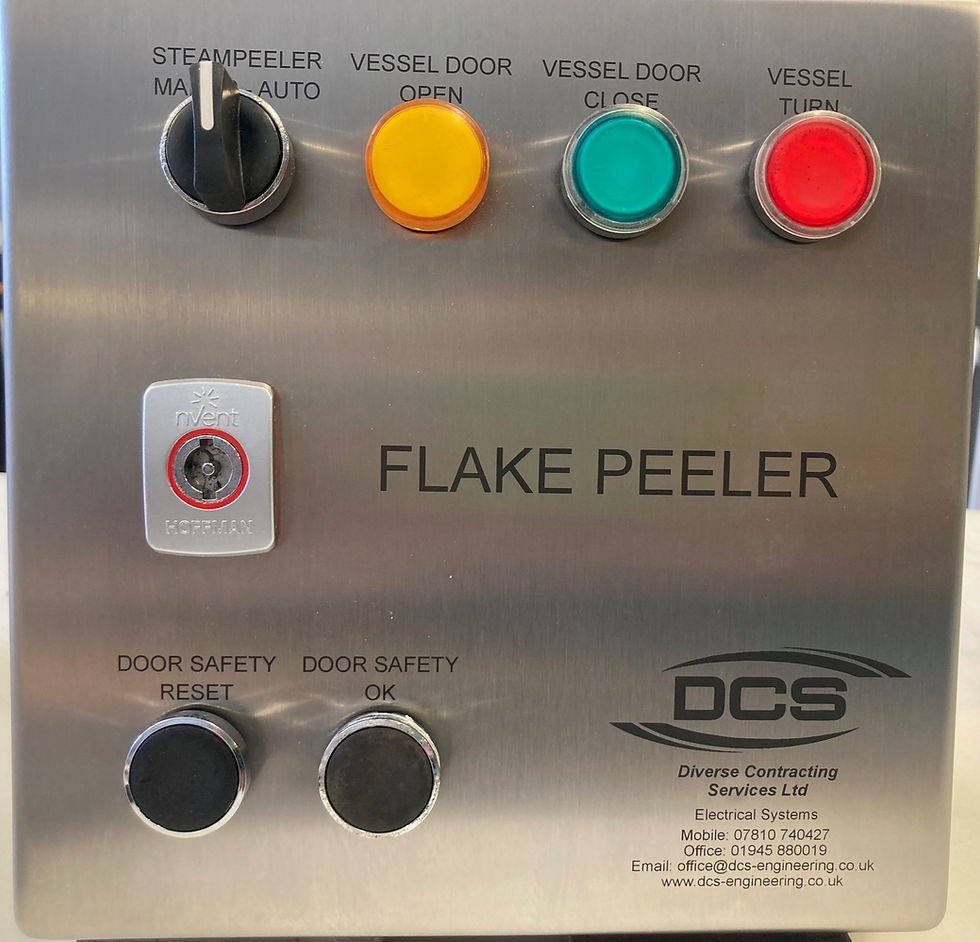
At Javik Laser, direct marking of stainless steel control stations has become one of our fastest growing services over the last few years. As more panel builders look to simplify assembly while producing cleaner, more integrated control systems, we're seeing an increasing number of OEMs replacing separate legends with permanent laser marking directly onto the enclosure itself.
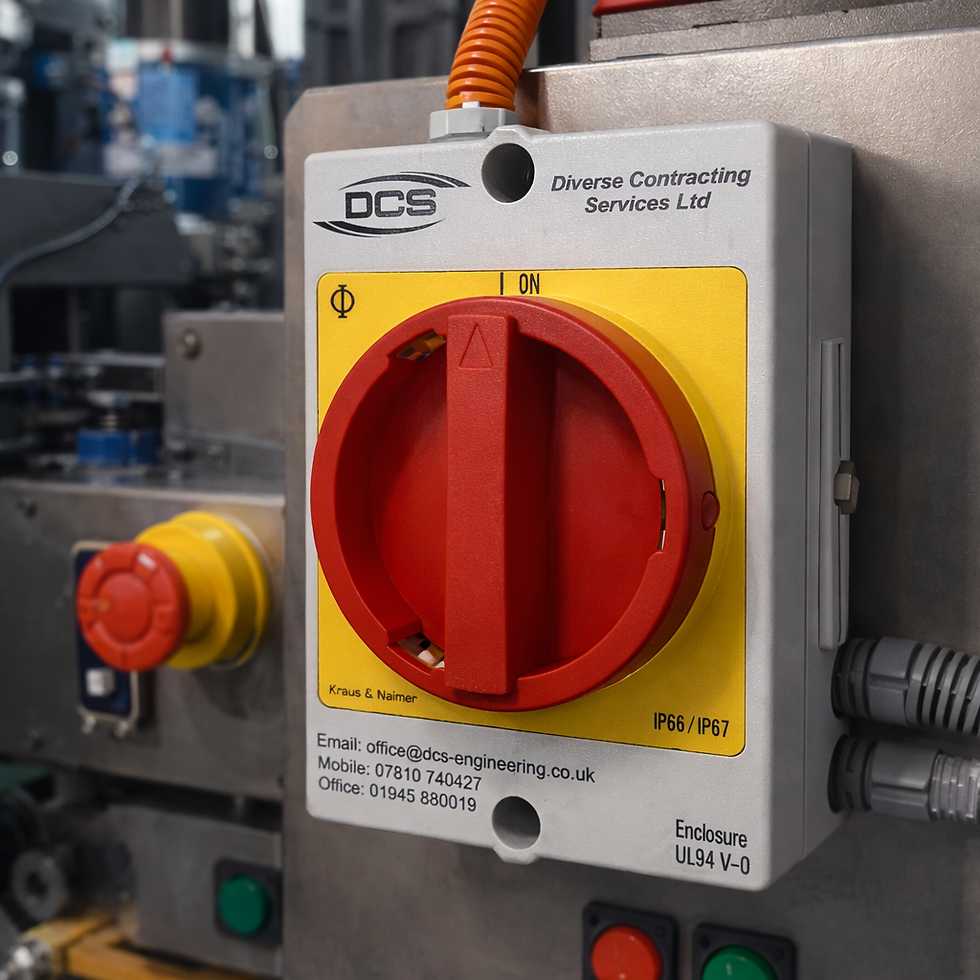
Stainless steel enclosure doors can be permanently engraved with operator legends, company branding and machine information, while plastic isolator switches and other control components can be laser marked with clear, durable text.
The result is a cleaner, more integrated control panel with fewer individual components to manufacture, fit and maintain.
But the move towards direct marking isn't simply about appearance.
Removing separate engraved legends also removes the need for adhesives, additional fixings and manual alignment during assembly. There are fewer parts to stock, fewer opportunities for labels to be fitted incorrectly and less risk of legends lifting, peeling or becoming damaged over time.
For many manufacturers, it also reduces assembly time. Once the enclosure or component has been marked, there are no separate legend plates to position, align or apply, helping to simplify the overall manufacturing process.
From a maintenance perspective, direct laser marking offers another significant advantage. Because the information is permanently marked into the component itself, it won't peel away, become detached during cleaning or require replacement after years of service. This is particularly valuable on stainless steel control stations used in food production, pharmaceutical manufacturing, chemical processing and other demanding industrial environments where equipment is cleaned frequently.
We regularly laser mark stainless steel electrical cabinet doors, industrial control stations and plastic isolator switches for OEMs, control panel builders and automation companies across the UK. Whether we're engraving a single bespoke enclosure or producing repeat batches for production equipment, direct component marking provides a professional, permanent finish that integrates seamlessly into the final product.
That doesn't mean traditional engraved legends have disappeared. They remain an excellent solution for many applications, particularly where controls may change over time or where existing installations need to be matched.
Why OEMs Are Choosing Direct Laser Marking
✓ Cleaner, more modern appearance
✓ No separate legend plates to fit
✓ No adhesive to fail over time
✓ Reduced assembly time
✓ Permanent, wear-resistant marking
✓ Easy to clean and ideal for hygienic environments
✓ Consistent, repeatable results for production builds
Which Control Panel Material Should You Specify?
Requirement | Recommended Material |
Lowest cost | Front engraved laminate |
Existing installation | Traffolyte |
High washdown | Reverse engraved acrylic |
Premium appearance | Powder coated paint fill |
Hygienic stainless equipment | Direct enclosure marking |
OEM production | Powder coated or direct marking |
Outdoor equipment | Stainless or anodised aluminium |
Final Thoughts
There has never been a wider choice of materials or manufacturing processes available for industrial control panels.
Traditional Traffolyte continues to serve many industries exceptionally well. Modern laser laminates provide outstanding flexibility and detail. Reverse engraved acrylic delivers a premium finish for demanding environments, while powder coated metal panels and direct laser marking are redefining how modern control stations are designed.
There is no universal "best" solution.
Only the most suitable one.
By understanding the strengths and limitations of each material, designers, OEMs and panel builders can specify control panels that not only look professional when installed but continue to perform reliably throughout the life of the machine.
That's ultimately what good engineering is all about.
Why choose Javik Laser Ltd?
Javik Laser Ltd provides permanent engraving, laser marking, industrial serial plates, control panels, legends as well as part marking services for machined components, engineering assemblies, tools and manufactured products across a wide range of industries.
Our fibre and C02 laser systems can produce durable, high-quality markings including:
Graduated scale markings
Serial numbers
QR codes
Data Matrix codes
Logos and branding
Traceability information
Permanent component identification

Whether you require a one-off prototype or production quantities, we can deliver
precise, durable markings designed for demanding industrial environments.
ISO 9001 Accredited | UK-Wide Service | One-Off Orders to Production Quantities
Contact Javik Laser today to discuss your requirements.